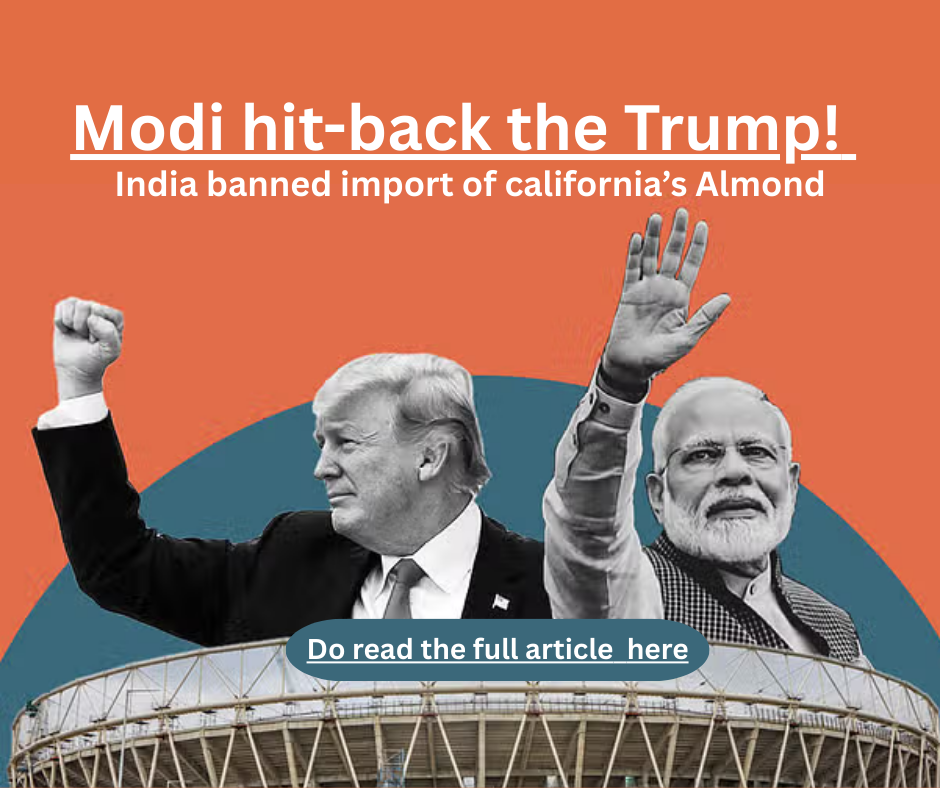
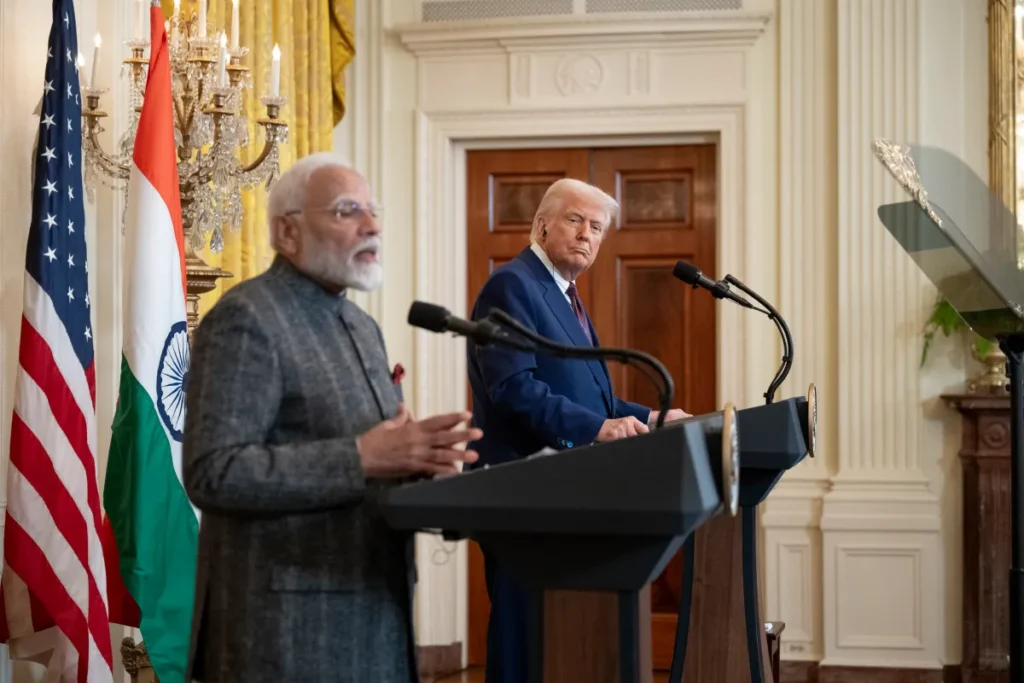
Indian Prime Minister Narendra Modi and President of USA Donald Trump in White House, USA
On a sweltering August morning in 2025, the Indian government delivered a stunning jolt to global agribusiness by announcing an immediate ban on the import of California almonds, a move widely seen as one of the most assertive responses yet in the recent escalation of trade hostilities between India and the United States. What followed was not just the blockade of a beloved ingredient from Indian confectioners and home kitchens, but a tectonic shift in international agricultural trade relations, geopolitics, and economic self-reliance.
The ban, administered through a notification by the Ministry of Commerce & Industry and meticulously enforced by the Directorate General of Foreign Trade (DGFT), set off a chain reaction at Indian ports. Containers carrying American-origin almonds, especially those from California—the heartbeat of the US almond industry—were summarily halted, inspected, and in most cases, returned to origin. This direct action did not emerge in isolation. It was the product of months of mounting trade friction, with India keen to assert its economic sovereignty and draw a line in the sand over what it called “unilateral and punitive” US tariff policies on crucial Indian exports, including steel and aluminium.
Within the global almond industry, the impact of New Delhi’s move was felt almost instantly. California supplies roughly 93 percent of all almonds consumed in India, and, until August 2025, India was far and away the largest importer for Californian almond growers, absorbing nearly 80 percent of their export volume every year(see the generated image above). The numbers are breathtaking: the annual value of the India-California almond trade regularly exceeded $1 billion, a lifeline for more than 6,800 almond farms based in California’s Central Valley—regions long dependent on Indian demand for their economic vitality.
The Specifics of India’s Ban and Its Enforcement
The ban was announced formally by the Ministry of Commerce and Industry, in strict coordination with the DGFT, who issued orders to customs and port authorities to suspend import licenses and reject all US almond shipments upon arrival. Media at the Jawaharlal Nehru Port and Mundra chronicled the unprecedented sight of California almond containers being repacked and dispatched back to America’s West Coast. Importers, caught off guard by the suddenness of the crackdown, scrambled to find alternative sources even as Indian retailers faced warnings of short-term shortages.
The government clarified in its official note that the embargo was laser-targeted: only US-origin, particularly California almonds, fell under the net. Imports from Australia, Chile, and Middle Eastern suppliers were unaffected and immediately began filling the breach caused by the US exclusion.
A Multi-Layered Motivation: Why Did India Act?
Trade friction was the primary trigger—a pointed riposte to the US administration’s repeated tariff hikes and restrictions on Indian steel, aluminium, and a swathe of manufactured goods. In the months leading up to the almond embargo, US tariff rates on certain Indian exports had soared, drawing strong protestations from the Indian side, which eventually ripened into a broad strategy to “hit where it hurts.” Almonds, a signature California export with limited alternate buyers of comparable scale, offered India an effective lever.
There’s another angle, too. Previous Indian security briefings had flagged misuse of US almond shipments through porous border routes—allegedly funding or facilitating cross-border terrorism activities. Although not foregrounded in this year’s official justification, the specter of agricultural trade intersecting with national security concerns set the context for policymakers and the public alike.
Finally, on the domestic front, Indian nut producers, especially in Kashmir, Himachal Pradesh, and parts of the Deccan, have long expressed unease over dependence on US imports, often alleged to be “dumped” at prices that squeeze out local growers. By invoking the “Atmanirbhar Bharat” (self-reliant India) policy, the government positioned the ban as not just economic retaliation, but a necessary boost for domestic agriculture.
A Geopolitical Chess Move: India’s Moment of Assertiveness
By enforcing a ban on a single commodity so critical to another nation’s export economy, India sent a clear signal: in the new multipolar world, it will not tolerate one-sided policies, and is both ready and able to defend its commercial interests. Analysts from both sides of the Pacific immediately recognized the high-stakes game in motion, with several noting that New Delhi was staking out its space as a key global player—unafraid to assert economic leverage, even at the risk of triggering a wider trade confrontation.
This move dovetailed with an ongoing trade war, as both countries levied increased tariffs on a range of imports—from US soybeans and crude oil to Indian garments and information technology products. Far from a localized dispute, the almonds ban emerged as a headline example of how international trade policy is now keenly entwined with questions of national dignity and geopolitical power.
How the USA Reacted: Industry Shockwaves and Political Uproar
In California, especially within the network of small and mid-sized almond farms, news of the Indian embargo landed like a thunderclap. Indian households, renowned for their consumption of almonds during festivals, daily snacking, and as gifts, had sustained the American almond industry for nearly a decade. Without Indian demand, nearly 80 percent of these exports now faced the threat of languishing in warehouses or being dumped at distressed prices elsewhere.
Political pressure quickly reached Washington, where US senators from California, along with the Almond Board of California, launched a coordinated outcry against both states’ policies. Statements poured in blaming not only Indian authorities for their “overreaction,” but also the US government itself, for unnecessarily antagonizing a vital trading partner through aggressive tariff actions. The outcry was underlined by fears of bankruptcies, layoffs, and a seismic drop in the price of Californian almonds for the foreseeable future.
The US Department of Agriculture, together with the United States Trade Representative (USTR), began consultations almost immediately, aiming to secure a diplomatic revision of the embargo and restore bilateral trust. At press conferences and trade symposiums, industry leaders warned that the broader American export sector could learn a hard lesson about overreliance on a single market for its prosperity.
Western and Global Repercussions: Opportunities and Warnings.
While Australia and Chile—with their rapidly growing almond industries—found themselves on the favorable end of the ban, Western commodity strategists treated the episode with caution. Australia, thanks to a previously signed import protocol with India, quickly stepped in to sell more nuts, capitalizing on its zero duty quota arrangement. Chile, although a much smaller player, also gained. However, both countries’ analysts and diplomats emphasized the necessity of diversified trade strategies, warning against long-term dependence on either Indian or American market whims
Indian importers, meanwhile, reached out to Middle Eastern and Asian suppliers. Asian-origin almonds, though different in quality and size, were propelled into the market, adding to price and supply volatility but also fostering experimentation with new supply chains.
A Mixed Basket: India’s Strategic and Economic Gain
With this embargo, the Indian government gained more than just negotiating leverage. New Delhi successfully (if abruptly) pressed the reset button on its trading relationship with Washington, demonstrating a willingness to wield its consumer market as an instrument of power.
On the strategic side, the ban was interpreted as a message to both current and potential trade partners: India is now negotiating from a position of strength, open to partnerships but resistant to coercive economic measures. The country’s strategic autonomy, often debated in international circles, was on full display, strengthening the government’s domestic and international position.
From the economic perspective, the move opened the path for rapid market diversification. Whereas India purchased more than 93 percent of its almonds from the US prior to August 2025, within weeks of the ban, importers redirected orders toward Australia, whose almond exports to India multiplied nearly fivefold. Chile, and to a smaller extent, Middle Eastern and Asian almond suppliers, saw their profiles rise.
For local Indian farmers and nut processors, the government’s bold stance was a windfall, instantly cushioning them against foreign price shocks and potentially boosting investment in domestic almond cultivation. Whether these benefits can be sustained and translated into long-term competitive strength remains to be seen.
Short-Term Shocks and Market Concerns in India
Original fears of immediate price spikes in major Indian markets were not misplaced. Retailers and wholesalers in Delhi, Mumbai, Hyderabad, and Kolkata reported a surge in prices, especially for premium quality almonds, in the days following the announcement. However, as supplies from Australia and Chile began to flow in and government advisories calmed speculator nerves, prices found a new equilibrium. Indian consumers, while missing some preferred varieties, embraced the alternatives, with many reporting satisfaction with Australian almonds.
Indian government officials moved to reassure the public that the embargo was a controlled, strategic measure—not a blanket ban on all almond imports. State governments, meanwhile, began issuing advisories to farmers on growing opportunities for domestic almond cultivation. The story made headlines even in daily vernacular news, underscoring its resonance across classes and regions.
The Road Ahead: Will the Ban Last?
Many questions persist around the long-term ramifications of this headline-making embargo. Will the Indian government permanently close the door to California almonds, or use the ban as a bargaining chip to secure more favorable overall trade terms with the United States? Sources close to the Ministry of Commerce indicate that ongoing talks could lead to calibrated relaxation or quotas, especially if Washington revises its approach to Indian steel and manufactured goods.
Meanwhile, with Australia, Chile, and smaller exporters like Turkey standing ready to meet Indian demand, the risk for the US almond industry is clear: complacency can give way to crisis in the globalized agro-economy, especially when single-market dependence meets sovereign retaliation.
Conclusions: New Rules for New Realities
India’s ban on California almonds in August 2025 will be noted in history as more than just a trade spat. It encapsulates the new assertiveness of rising economies, the recalibration of global commodity supply chains, and the growing role of national food security in the calculus of international relations. For Indian consumers, it was a moment of reckoning—a sudden absence of a familiar flavor, but also a step toward greater self-reliance and consumer sovereignty. For US farmers and global markets, it stands as a potent lesson in the perils and possibilities of modern trade.
For government documents, detailed statistics, and further analysis, see:
Ministry of Commerce & Industry releases on almond import guidelines (https://www.pib.gov.in/PressReleasePage.aspx?PRID=1956692)
Economic Times coverage on almond trade disruption (https://economictimes.com/news/economy/foreign-trade/us-dominates-indias-almond-and-pistachio-imports/articleshow/118176478.cms)
Almond Board of California trade impact analysis (https://www.almonds.com/sites/default/files/2023-05/2023GTRA0014_MayGlobalUpdate.pdf)
India Infoline blog on India’s retaliatory tariffs (https://www.indiainfoline.com/blog/tariffs-at-50-take-off-now-for-the-indian-response)
United States Department of Agriculture (USDA) tree nut annual report (https://apps.fas.usda.gov/newgainapi/api/Report/DownloadReportByFileName?fileName=Tree+Nuts+Annual_New+Delhi_India_IN2023-0068.pdf)