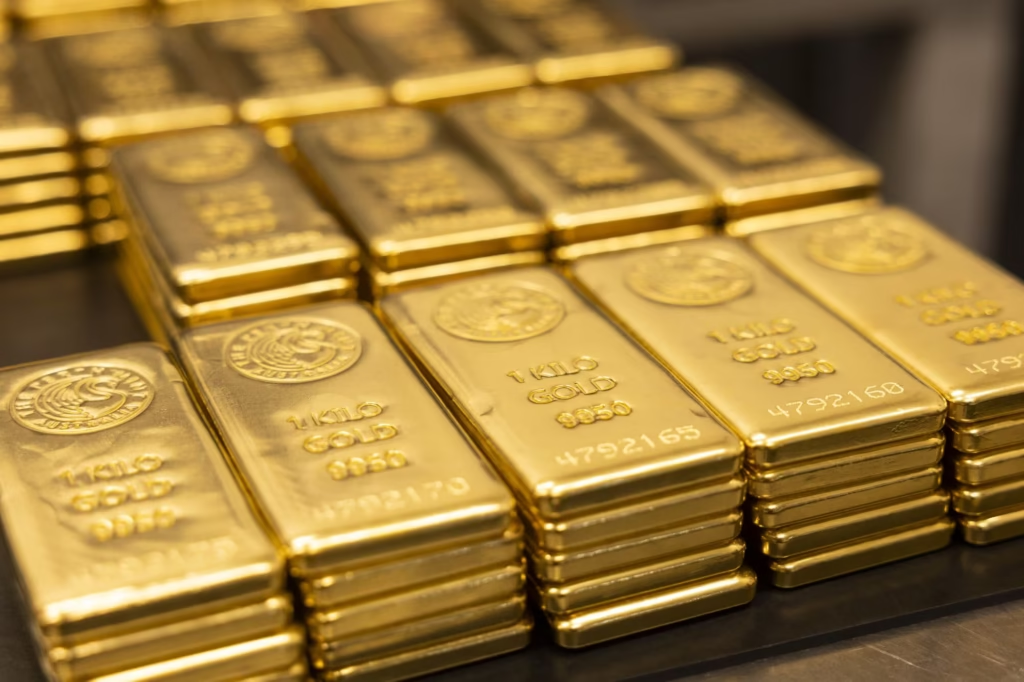
As of September 26, 2025, the Reserve Bank of India’s (RBI) gold reserves surged to 880.18 metric tonnes, valued at approximately $95 billion. This milestone marks a notable point in India’s foreign exchange reserve management, showing a considerable shift towards gold accumulation amid global economic uncertainties. By October 10, just a few weeks later, the value of these gold reserves crossed the $100 billion threshold, propelled by a remarkable 65 percent rally in international gold prices reflecting global market volatility.
Growth in RBI’s Gold Holdings Reflects a Strategic Monetary Move
Gold has traditionally been a vital part of a country’s foreign reserves. It serves as a hedge against currency devaluation, inflation, and geopolitical tensions. India’s RBI has intensified its gold purchases recently, signaling its intent to strengthen monetary sovereignty and reduce dependence on foreign currency assets, especially in times of global financial unpredictability.
The current composition of India’s foreign exchange reserves reveals that gold now represents 13.6 percent of the total reserves. This is a significant increase from just 9.3 percent a year earlier, when the overall foreign exchange reserves had reached an all-time high. This strategic diversification highlights India’s approach to balancing risk by increasing its exposure to gold, which is regarded worldwide as a safe haven asset during economic downturns or political tensions.
Background: India’s Foreign Exchange Reserves and Gold Ratio
India’s foreign reserves comprise several components, including foreign currency assets, special drawing rights, reserve tranche position at the International Monetary Fund (IMF), government securities, and gold. Over the last few years, while foreign currency assets—especially US Treasury securities—have formed the largest chunk, the importance of gold has steadily increased.
By September 2025, more than one-eighth of the reserves were in gold, underscoring a trend wherein RBI is cautiously lowering its exposure to US dollar assets. This move aligns with broader global dynamics of monetary sovereignty and global de-dollarization where countries aim to reduce vulnerability to currency swings, geopolitical risks, and trade tensions dominated by dollar-denominated transactions.
Factors Contributing to Increased Gold Reserves
The surge in the RBI’s gold reserves coincides with two major global economic developments. First, the international gold price saw an unprecedented rally, rising by 65 percent over a short period which pushed the valuation of RBI-held gold above the $100 billion mark. Second, geopolitical tensions such as tariff wars and sanctions led to a reorganization of reserve assets by central banks worldwide.
In August 2025, the United States, under President Donald Trump’s administration, imposed 50 percent tariffs on several Indian imports. One of the key reasons cited was India’s continued purchases of Russian oil despite geopolitical pressures. The tariff imposition posed challenges to trade relations, leading India to strategically recalibrate its foreign reserves by boosting gold holdings and cutting back on US Treasury securities.
Reduction in US Treasury Holdings by India
Alongside increasing gold stocks, the RBI has decreased its holdings in US Treasury securities. From June to July 2025, India’s US Treasury holdings fell from $227.4 billion to about $219 billion. This is part of a trend starting a year ago, as these holdings stood at approximately $238.8 billion, reflecting a cautious approach amid rising US-India tensions and global uncertainty.
This decline in US Treasury assets is also closely monitored by market analysts as it indicates India is reducing reliance on dollar assets, which may be exposed to dollar volatility and political leverage, especially in light of US tariffs on Indian goods.
Recent Gold Purchases by RBI
During the six months ending September 2025, the RBI added a modest 0.6 metric tonnes of gold to its reserves. The purchases occurred mainly in two batches: 400 kilograms in June and 200 kilograms in late September. While these numbers may appear small, they represent a noticeable addition when viewed against the large stock of gold already held by India.
The pace of these purchases reflects RBI’s cautious but steady acquisition strategy focused on strengthening reserves in an inflationary and uncertain economic environment. The incremental buildup also illustrates prudent reserve management without causing disruption in global gold markets.
Geopolitical and Economic Implications
India’s growing gold reserves and simultaneous reduction in US Treasury holdings precisely capture India’s evolving geopolitical stance and economic strategy. India is actively seeking to diversify its foreign reserve assets to insulate itself from trade conflicts and geopolitical pressures. The move towards gold highlights a broader ambition to assert greater monetary sovereignty and reduce exposure to dollar-linked vulnerabilities.
Domestic politics also play a role, as the government pursues an independent foreign policy balancing relations with major powers like the US and Russia. Reports suggest ongoing negotiations between India and the US may lead to a significant reduction in tariffs from the current 50 percent to an estimated 15-16 percent, contingent on India reducing its Russian oil imports. This potential trade deal could ease tensions and stabilize bilateral economic ties, impacting India’s reserve management strategy in the near term.
Why Gold Remains a Favored Reserve Asset
Gold has been prized through centuries for its intrinsic value and scarcity. Unlike fiat currencies, gold is not subject to inflationary policies or debt-driven devaluation. For central banks like the RBI, it provides unmatched liquidity and stability, especially in times of financial crisis.
Moreover, gold acts as a hedge against geopolitical risk and a protective instrument during currency wars and trade disputes. The Indian government’s current aggressive accumulation reflects this strategic understanding amid global uncertainty, including rising inflation, trade protectionism, and shifting power equations.
Historical Context of India’s Gold Reserves
India has always maintained a significant portion of its reserves in gold, given centuries-old cultural and economic affinity towards the metal. Traditionally, Indian households have also held large quantities of gold, which underpins the nation’s positive sentiment towards the metal.
The RBI’s growing stockpile signals a renewed commitment to this heritage, adapting it to modern monetary policy. The value of gold reserves steadily increased from hundreds of tonnes 10 years ago to nearly 880.18 metric tonnes today, indicating consistent central bank policy supporting gold as a cornerstone asset.
Detailed Statistical Overview
By September 26, 2025, RBI’s gold holdings reached exactly 880.18 metric tonnes. This amount is valued at $95 billion based on prevailing international prices. However, international price volatility pushed the valuation beyond $100 billion barely two weeks later by October 10.
The gold reserves formed 13.6 percent of India’s overall foreign exchange reserves, compared to only 9.3 percent the previous year. The year-on-year increase in gold’s share coupled with the absolute increase in tonnes held demonstrates RBI’s strategic diversification.
Meanwhile, the reduction in US Treasury securities from $238.8 billion a year ago to $219 billion in July 2025 illustrates a deliberate trimming of dollar assets amidst trade disputes and tariff threats from the US government.
The actual addition of gold stock in the six-month period was small but significant, at 0.6 tonnes (600 kilograms), with two purchases recorded: 400 kilograms in June and 200 kilograms in September.