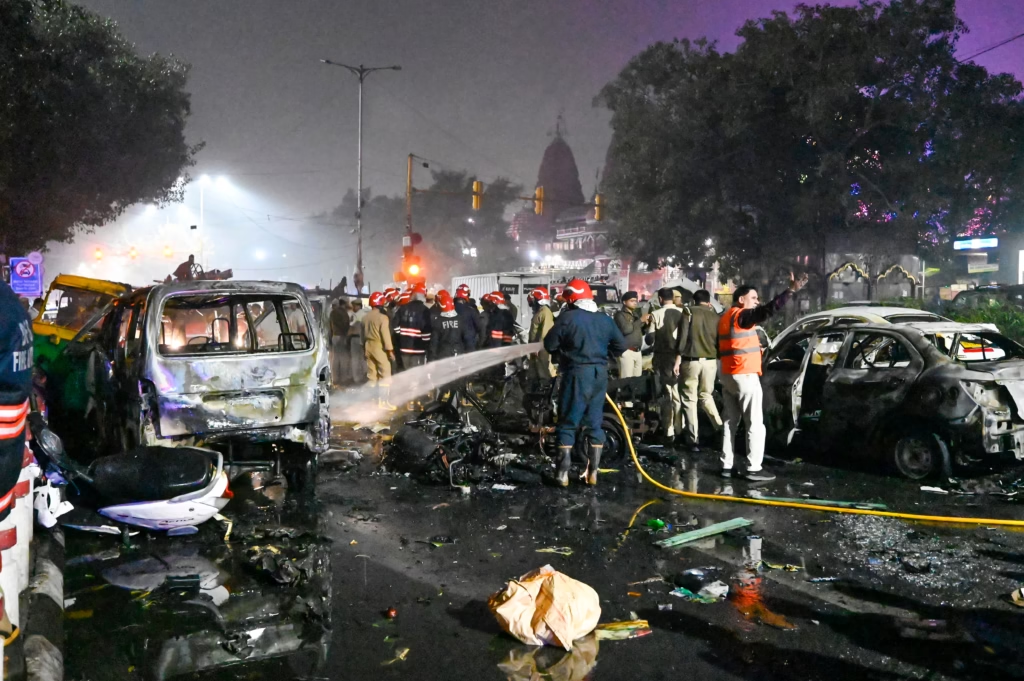
In the early hours of November 10, 2025, India witnessed one of its most sophisticated and chilling terror incidents when an improvised explosive device detonated near the historic Red Fort in Delhi. The shockwaves from the blast went far beyond the city’s walls, reverberating across the country and immediately triggering a national security emergency. Intelligence agencies quickly unraveled that this attack was not a standalone act but the calculated endgame of a meticulously planned operation rooted in what experts now call “white collar terrorism.” The unfolding narrative of the Red Fort blast, linked to Faridabad’s ammonium nitrate haul earlier the same day, has forced the country to confront a far more complex and homegrown threat, where doctors, engineers, and religious leaders orchestrate terror from beneath the respectable veneer of middle-class professionalism.
The Rise of White Collar Terrorism in India
Traditionally, India’s internal security apparatus had been attuned to militancy flowing in from across borders, with typical operatives being foot soldiers trained in hostile terrain. White collar terrorism, however, has upended this paradigm. For the first time, educated professionals such as medical doctors, teachers, and clerics have been systematically recruited by terrorist organizations to plan and execute attacks. The Red Fort incident is a prime example of this evolution. Counterterror officials, citing high-level intelligence and government sources, confirmed that individuals like Dr. Mujammil Shakeel, a Faridabad-based medical college faculty member, and Dr. Shaheen Shaheed, a well-respected Lucknow doctor, played central roles in sourcing, transporting, and managing deadly explosives for the attack.
What makes white collar terrorism so dangerous is the degree of access and legitimacy afforded to such professionals. Unlike traditional operatives, these individuals use their professional stature to move hazardous materials undetected, exploit hospital networks for medical chemicals, and facilitate clandestine recruitment among their peers. The involvement of these professionals in terrorism was painstakingly uncovered in a joint investigation by the Intelligence Bureau (IB), National Security Guard (NSG), Research & Analysis Wing (RAW), and Delhi Police, which has since become a blueprint for counterterror response nationwide.
The Faridabad Connection: Ammonium Nitrate, Logistics, and the New Face of Terror
The breakthrough in the Red Fort case came hours before the blast, when Faridabad Police, acting on an intelligence tip, raided the premises of Dr. Mujammil Shakeel. What they uncovered shocked even senior officers: over a hundred kilograms of ammonium nitrate, enough to build several powerful bombs, stored with meticulous care and camouflaged as laboratory supplies. The investigation revealed an underground logistics chain. Dr. Shakeel was the nucleus of a network that procured and stored raw materials, then passed them on to field operatives using coded communications. His associate, Dr. Shaheen Shaheed, managed a parallel system focused on transportation, using medical supply vehicles and fake credentials to move contraband safely across state lines.
This setup is unlike anything India’s internal security agencies had previously encountered. According to RAW’s post-blast analysis, the terrorists exploited gaps in industrial chemical regulations and leveraged doctor-patient confidentiality and hospital transit records to avoid detection. The Faridabad ammonium nitrate bust was directly linked to the Red Fort blast—confirming forensics found the explosive used in Delhi was from the same seized cache.
Behind these operations stand ideologues like Dr. Adil Ahmad, whose work included distributing pamphlets, digital propaganda, and recruitment within educated circles. Another key node in the web was Imam Ishteyaq, a religious scholar in Faridabad, tasked with indoctrination and clandestine recruitment at a local level, mainly through private gatherings in mosques and community centers.
The Strategy Shift Post Operation Sindoor
According to senior intelligence officials and corroborated by recent counterterrorism government reports, a turning point in this paradigm shift was “Operation Sindoor,” conducted in May 2025. The Indian security forces struck at Jaish-e-Mohammed (JeM) bases in Bahawalpur, severely crippling the group’s Pakistan-based leadership. In retaliation, Pakistan’s Inter-Services Intelligence (ISI) radically restructured its operational tactics. Rather than relying on externally sourced fighters, ISI focused on creating deeply embedded Indian sleeper cells comprised of nationals from educated, respected backgrounds.
ISI’s comprehensive module, as detailed by Pavneet Singh and supported by intelligence statements, functions in four primary compartments: logistics (securing resources and safe houses), finance (funding through a mix of legitimate business fronts and charitable trusts), ideology (aggressive online and offline radicalization and micro-mobilization), and operations (execution by individuals with minimal criminal background). Decentralization became the operative word. Individuals at each operational stage were deliberately cut off from knowledge of the full hierarchy or network actors, making detection and prosecution significantly more complex.
Role of Indian Security Agencies: From Surveillance to On-Ground Action
Following the Red Fort blast, a rapid multi-agency response was set in motion, exemplifying the increasingly sophisticated coordination among India’s security organs. The Intelligence Bureau had tracked suspicious online chatter and encrypted communications among medical professionals weeks before the events. The Research & Analysis Wing provided critical input on foreign funding routes, especially those linked to charity fronts in the Gulf and Europe. Delhi Police, now trained in advanced digital forensics and aided by real-time surveillance technology, managed on-the-ground arrests and safely defused secondary devices planted near the Red Fort perimeter.
NSG bomb disposal teams entered the Red Fort site mere minutes after the initial explosion to sweep the historic monument for additional threats and carry out rapid chemical forensic analysis on the remnants of the detonated device. This combined response ensured both rapid identification of operatives and prevention of further casualties in the sensitive Delhi region. According to the Ministry of Home Affairs (MHA), such synergy between agencies has been enshrined in new national counterterror protocols adopted after the 2025 attack.
Ammonium Nitrate and the Chemical Warfare Threat
Perhaps the gravest threat emerging from white collar terrorism, as highlighted in government intelligence circulars, is the potential for chemical and biological warfare. Ammonium nitrate, a common fertilizer, is strictly regulated after its use in several past bomb attacks. However, the Red Fort case demonstrates the ease with which determined professionals can obtain, store, and weaponize industrial chemicals. Security analysts point out that medical colleges offer access not just to explosive precursors, but also to a range of volatile chemicals and even pathogens, raising genuine concerns about future attacks veering into bioterrorism.
The Indian Army Chief and Chief of Defence Staff have openly warned of this risk in recent security briefings. Their reports, accessible via PIB India’s Ministry of Defence press releases, emphasize the urgent need for new regulatory protocols, mandatory chemical audits in hospitals and colleges, and enhanced cross-state tracking of both ammonium nitrate and other sensitive substances.
Women in Terrorism: The Rise of the “Women’s Wing”
An equally worrying trend revealed in the Red Fort investigation is the deliberate recruitment of women by terror modules. Jaish-e-Mohammed, adapting to increased surveillance of male suspects, has set up dedicated women’s wings especially in Kashmir and northern metropolitan centers. Government data cited in NIA annual reviews show that over half a dozen women have been arrested or under watch for logistical and operational roles since January 2025. In the Faridabad-Red Fort module, women operatives are suspected to have been used for transportation, intelligence gathering, and media propaganda due to stereotypes that render them less suspicious in public spaces.
Radicalization and recruitment happen through encrypted chats, social media advocacy, private community outreach, and, disturbingly, sometimes via female educators and healthcare workers. Authorities now recognize women operatives not just as couriers or propagandists, but potential attackers involved in hands-on planning and execution. The presence of Dr. Shaheen Shaheed in a leadership transport role marks the first time such a senior female professional has been central to a major urban bomb plot.
The Web of Organizations: Jaish, Lashkar, Ansar Ghazwat-ul-Hind, and ISI
As revealed through inter-agency interrogations and outlined in the MHA dossier on urban terrorism, the backbone of the plot is a three-tier support structure. Logistic and financial backing is provided by Jaish-e-Mohammed and Lashkar-e-Taiba, using legitimate businesses and religious trusts to launder funds and provide cover for operatives inside India. For actual execution and ideological leadership, they rely on Ansar Ghazwat-ul-Hind—a group established in 2017 by Zakir Musa, a former Hizbul Mujahideen radical with operational links to Al Qaeda.
ISI, Pakistan’s notorious intelligence service, is identified as the strategic mastermind. Their approach now focuses on “plausible deniability,” ensuring no direct Pakistani terrorist or contact can be linked to attacks in India. Instead, ISI orchestrates from behind the scenes, using local actors, encrypted digital tools, and complex financial trails. This method allows them to defend themselves in international forums, passing off the attacks as “homegrown” or “international jihadi” efforts.
Homegrown Terror and the Bioterror Threat: Key Findings
Recent debriefings from IB and NIA highlight a marked increase in educated Indians, often with minimal religious or criminal backgrounds, recruited into terror networks. This homegrown character is not coincidental. ISI deliberately targets such individuals for their perceived legitimacy, professional access, and low risk profile. Notably, almost all operatives apprehended as part of the Red Fort module were Indian nationals with advanced degrees or professional training.
Security agencies now grapple with the fresh challenge of bioterrorism. With doctors and other professionals in its ranks, a terror cell could potentially weaponize biological agents or toxins. This chilling prospect has led to a nationwide review of laboratory and hospital security, with special advisories issued by the Indian Council of Medical Research (ICMR), which calls for vigilance in the storage and transport of all sensitive medical substances.
How India is Fighting Back: Legislation, Technology, and Collaboration
In the aftermath of the Red Fort blast, India’s counterterror response has become a multi-pronged campaign. New amendments to the Unlawful Activities (Prevention) Act (UAPA) and National Investigation Agency (NIA) Act have broadened the state’s powers to surveil suspects, freeze terror-related assets, and prosecute organizations using digital, financial, or logistical support for such crimes.
Nationwide, the government is expanding deployment of surveillance technology anchored by artificial intelligence, digital financial tracing, and forensic data analytics—tools previously reserved for high-value interstate crime. Coordination with foreign security agencies has also been intensified, especially with European counterparts to track movements of funds, radical literature, and communications bearing Pakistan-linked fingerprints.
Integrated task forces now conduct regular drills for chemical, biological, and radiological disaster preparedness, while NSG protocols for rapid response at heritage and religious sites have been updated to reflect evolving threat profiles.
Lessons Learned and the Road Ahead
The Red Fort suicide blast underscores the dramatic transformation in India’s terror threat landscape. No longer can law enforcement focus solely on cross-border infiltration or suspect profiling based on past indicators. The new face of terrorism is deceptively familiar: doctors, teachers, clerics, engineers—respectable professionals hiding in plain sight—a web spun by Pakistan’s ISI, funded by legal businesses, enacted by Indian nationals, enabled by modern technology and ideology.
As ongoing investigations reveal more sleeper cells, both the public and law enforcement must remain vigilant not only against visible acts of violence but also invisible, gradual recruitment that can turn white coats into purveyors of destruction. Every Indian institution—hospital, mosque, college, business—now has a role to play in this continuing fight.
For authentic government data, readers are encouraged to consult the official press releases and annual reports published by the Ministry of Home Affairs and the National Investigation Agency, which provide detailed information on terror trends and countermeasures. This networked, “white collar” strategy is one of the gravest national security challenges of our time, demanding sustained institutional vigilance, public awareness, and global collaboration if India is to prevent such tragedies in the years ahead.
Source Citations:
https://pib.gov.in/PressReleaseIframePage.aspx?PRID=1945112
https://nia.gov.in/writereaddata/Portal/News/383_1_Annual_Report_2025.pdf
https://mha.gov.in/sites/default/files/UrbanTerrorism2025.pdf
https://www.icmr.gov.in/bioterrorism.html
https://www.youtube.com/watch?v=vVYEQEzbF3E